


Bangalore STRR vs PRR: Key Differences Every Property Investor Should Understand
- 1 hour ago
- 6 min read
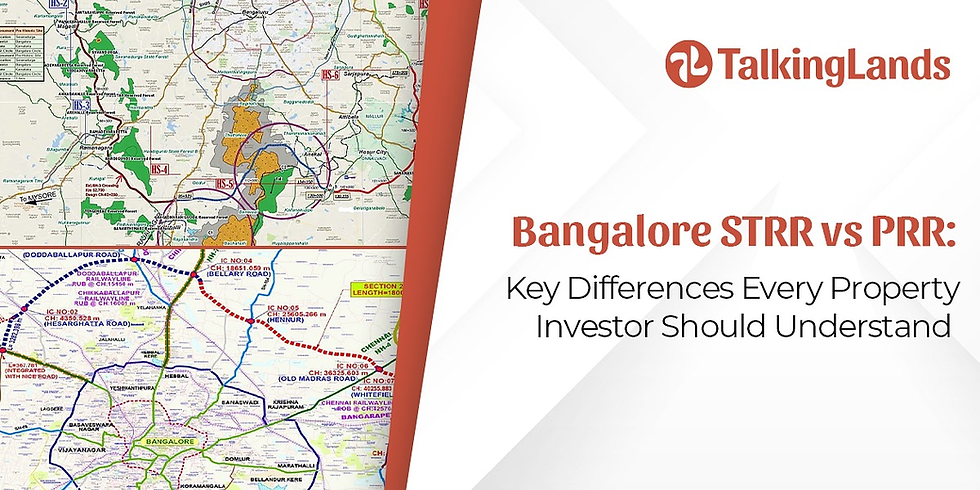
Bangalore’s growth story isn’t subtle anymore. It’s visible in traffic, in construction cranes, in how far the city has stretched over the last decade. Infrastructure has quietly been doing most of the heavy lifting here and more often than not roads decide where the next real estate wave goes.
Ring roads especially.
We’ve seen this before with the Outer Ring Road. Areas that once felt far suddenly became central. Prices followed. The same pattern is starting again but this time with two very different projects: STRR and PRR.
At first glance they sound similar. Both are ring roads. Both promise better connectivity.
But that’s where the similarity ends.
Understanding the Bangalore STRR vs PRR difference isn’t just useful, it can directly affect where you invest, how long you hold and what kind of returns you realistically expect.
What is STRR (Satellite Town Ring Road)?
The Satellite Town Ring Road or STRR is not really a “Bangalore road” in the usual sense. It sits far outside the city looping around multiple satellite towns and growth zones.
Planned and executed by the National Highways Authority of India, STRR is part of a larger national infrastructure push. Think of it less as a city project and more as an economic corridor.
It stretches close to 300 km. That’s massive.
It connects places like Doddaballapur, Devanahalli, Hoskote, Sarjapur and Ramanagara.
The idea is simple. Heavy vehicles and long-distance traffic shouldn’t be entering Bangalore at all. STRR creates a bypass so they don’t have to.
But here’s what actually happens.
Where logistics moves, land demand follows. Warehousing comes in. Then industries. Then residential pockets slowly begin forming around them.
Not immediately. But steadily.
What is PRR (Peripheral Ring Road)?
PRR sits much closer to the city. And that changes everything.
Planned by the Bangalore Development Authority, the Peripheral Ring Road is meant to ease traffic inside Bangalore by creating a parallel high-speed corridor just outside the existing ORR.
It’s shorter around 65 to 75 km but far more directly connected to daily city life.
The route cuts through major growth zones like Yelahanka, skirts around Whitefield and connects to corridors like Sarjapur and Kanakapura Road.
On paper it’s about decongestion.
In reality it’s about expansion.
Because once commute times drop areas that felt “too far” suddenly don’t.
And that’s when residential demand kicks in.
Key Differences Between STRR and PRR
Purpose & Planning
STRR is designed to keep traffic out of Bangalore. PRR is designed to make movement within Bangalore easier.
That sounds obvious. It usually isn’t.
STRR supports freight, industry and long-distance connectivity. PRR supports daily commuters, IT employees and residential movement.
Different users. Different outcomes.
Coverage Area
STRR operates on the outer edge almost like a second boundary for the region.
PRR sits just outside the current city limits closer to where people already live and work.
One is future-facing. The other is present-focused.
Governing Authority
STRR falls under the National Highways Authority of India.
PRR is managed by the Bangalore Development Authority.
This matters more than most investors realise.
Central projects tend to move differently often faster in execution phases. City-led projects especially in Bangalore tend to face land acquisition delays.
That’s the catch.
Project Scale & Length
STRR is nearly 300 km. PRR is about a fourth of that.
But scale doesn’t always equal impact.
STRR spreads its influence across regions. PRR concentrates it within high-demand urban belts.
Impact on Real Estate
STRR influences land first. Then development.
PRR influences housing demand almost immediately.
One builds value slowly. The other tends to accelerate it faster.
Factor | STRR | PRR |
Purpose | Regional connectivity, logistics | Urban decongestion, city mobility |
Location | Outer periphery | Near city limits |
Length | ~300 km | ~65–75 km |
Authority | NHAI | BDA |
Development Stage | Partial completion | Delayed |
Real Estate Impact | Long-term land growth | Immediate residential demand |
Investment Type | Plots, land banking | Apartments, end-use housing |
STRR vs PRR: Route & Connectivity Comparison
Key Areas Covered by STRR
STRR loops through satellite towns and connects major highways eventually linking back to hubs like the Kempegowda International Airport.
Places like Devanahalli and Hoskote stand out here.
Not because they’re fully developed today but because they’re positioned for what comes next.
Key Areas Covered by PRR
PRR cuts through zones that are already active.
Yelahanka.
Sarjapur.
Kanakapura Road.
These are not emerging markets. They’re evolving ones.
Which means pricing reacts faster.
Connectivity
STRR connects highways. PRR connects people.
STRR improves long-distance efficiency. PRR reduces daily commute friction.
Different problems being solved. Different investment signals.
Connectivity Type | STRR | PRR |
Airport Access | Direct | Indirect |
IT Hubs | Limited | Strong |
Highways | Extensive | Moderate |
Logistics Corridors | Strong | Limited |
Impact on Bangalore Real Estate Market with STRR & PRR
STRR Impact
STRR changes how Bangalore expands geographically.
Land around corridors like Devanahalli starts seeing interest first from investors then from developers.
Industrial activity builds quietly in the background. Logistics hubs follow.
Residential demand comes later.
That delay is important.
Because it’s where early investors usually benefit.
PRR Impact
PRR works faster.
The moment connectivity improves housing demand rises. Especially in areas like Sarjapur.
Developers respond quickly. Inventory increases. Prices start moving.
Rental demand also improves because IT corridors become easier to access.
This is where things shift.
PRR doesn’t wait for the future. It pulls demand into the present.
Which is Better for Property Investment?
STRR – Best For
STRR suits investors who are comfortable waiting.
Land buyers. Plot investors. People looking at a 5–10 year horizon.
Not for quick returns.
But for those who enter early and hold the upside can be significant.
PRR – Best For
PRR is more straightforward.
If the goal is rental income, faster appreciation or end-use housing this is where most activity will be.
Less waiting. More visibility.
But also higher entry prices.
Price Trends Around Bangalore STRR vs PRR Corridors
Pricing tells the story quite clearly.
STRR zones like Hoskote still offer relatively lower entry points. Growth here tends to be gradual but steady.
Areas like Devanahalli have already seen appreciation due to airport-led development but there’s still room.
PRR zones are different.
Yelahanka and Sarjapur are already active markets. Prices here reflect current demand not just future potential.
So the gap exists.
And that gap is exactly what investors evaluate.
Future Growth Potential
Both STRR and PRR are tied to larger infrastructure shifts.
The expansion of Kempegowda International Airport will continue to push North Bangalore forward.
Metro expansions will support PRR corridors more directly.
Industrial corridors around Hosur and logistics zones near STRR will shape long-term demand.
In most cases STRR drives where the city will go.
PRR defines how the city grows right now.
Conclusion
If you strip away the technical details the Bangalore STRR vs PRR comparison becomes simpler.
STRR is about future value. PRR is about current momentum.
One requires patience. The other rewards timing.
Most investors try to choose between the two.
In reality a balanced approach if capital allows usually works better.
Because Bangalore rarely grows in just one direction.
FAQs: Bangalore STRR vs PRR
What is STRR in Bangalore?
It’s a large outer ring expressway connecting satellite towns and enabling regional growth beyond the city.
What is PRR in Bangalore?
A planned ring road closer to the city aimed at reducing traffic and improving connectivity between major corridors.
What is the difference between STRR and PRR?
STRR operates at a regional level. PRR works at a city level. Their impact on real estate is very different.
Which is better for investment STRR or PRR?
Depends on your timeline. STRR suits long-term bets. PRR works better for quicker returns.
How does STRR impact property prices?
It increases land demand in outer areas over time especially near industrial and logistics zones.
How does PRR impact real estate in Bangalore?
It boosts residential demand almost immediately by improving connectivity.
Which areas benefit from STRR development?
Places like Devanahalli and Hoskote.
Which areas are covered under PRR?
Corridors including Yelahanka and Sarjapur.
Is STRR completed in Bangalore?
Not fully. Some stretches are operational while others are still under development.
What is the future of PRR in Bangalore?
Progress depends on land acquisition and approvals but its impact is expected to be significant once executed.


